Definitions
Functions
- Hides implementation details so they can be changed later without affecting other parts of the code
- Allows for reuse of computations, makes code more succinct and easier to change
Statically typed language
- Declare every variable used and its type
- Type of variable cannot be changed after declaration
Strongly typed
- Enforces strict rules in type system to ensure type safety
- Only allow type casting if it makes sense
Method signature
- method name, number of parameters, type of each parameter and its order
- C::foo(B1, B2)
Method descriptor
- Method signature + return type
- A C::foo(B1, B2)
Overriding
- Uses @Override annotation
- Same method descriptor as parent class
- Return type must be a subtype of the overridden method’s return type
Overloading
- Same method name in the same class
- Different method signature
- Same method signature with different return type is not allowed
- By either changing type, order or number of parameters but keeping the method name identical
- Can overload constructors as well
Interface
- Specifies a set of methods a class must implement
- Methods are abstract by default
Abstract classes
- Cannot be instantiated
- Contains both abstract and concrete methods
Checked exceptions
- Programmer has no control over exception
- Handled with try, catch and finally blocks
- Checked in order of catch blocks
- Overriding a method that throws a checked exception must throw the same or more specific checked exception
Unchecked exceptions
- Programmer has control over
- Runtime Exceptions
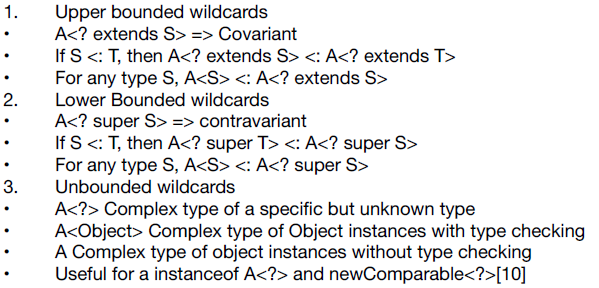
Producer Extends, Consumer Super (PECS)
Parallel and Concurrent programming
- Sequential: 1 instruction of program running at a time
- Concurrency: divide computation into subtasks and switch between concurrent processes to give the illusion of running at the same tinme
- Subtasks known as threads
- Parallelism: subtasks running at the same time
- With multiple cores/processors
All parallel programs are concurrent, but not all concurrent are parallel
Java concurrent programming
- Threads
- CompletableFuture
- Fork and Join Pools
- Collection of threads, each waiting for a task to execute, and a collection of tasks to be executed
OOP Principles
Encapsulation
- Bundling of fields and methods into a class
- Maintains abstraction barrier
- Reference type stores the reference to the value, null if not initialised
Information Hiding
- Private instance fields, public methods
Composition
- has-a relationship between 2 classes
- Aliasing: sharing same reference values
Tell don’t ask
- Tell the object what to do instead of asking for its state and performing the task on its behalf
Inheritance
- Ability to reuse code of existing super classes
- is-a relationship
Polymorphism
- Using same method signature in subclasses to determine behaviour for specific subclasses
- Works due to dynamic binding, method invoked is decided during run-time, based on its run-time type
Liskov Substitution Principle (LSP)
- Let (x) be a property provable about objects x of type T. Then (y) should be true for objects y of type S where S <: T
- A subclass should not break the expectations set by the superclass
- If a class B is substitutable for a parent class A, then it should be able to pass all test cases of the parent class A
Java syntax and the way it works
Class fields
- Static fields:
public static final double PI - Accessed with class name
Class methods
- Cannot access instance fields or call other instance methods
Main method
public static final void main(String[] args)
Stack and Heap
Stack
- Variables are allocated and stored here
- Instance and class fields are not in the stack
- Call frames are created when we invoke a method and removed when it completes (variables are contained within this)
Heap
- Region in memory to allocate and store objects
- New objects created in heap when the new keyword is used
- Objects can persist across multiple methods and can be shared
Dynamic binding
- Determine compile-time type C of target
- Check all accessible methods in C (including inherited methods)
- Choose the most specific method (method M is more specific than method N if arguments to M can be passed to N w/o compilation error)
- Store the method descriptor in the bytecode
- Determine run-time type of target
- Look for an accessible method with matching method descriptor (first matching method descriptor found is chosen, find upwards)
Wrapper classes
- Autoboxing: convert primitive to wrapper
- Unboxing: convert wrapper to primitive
- All primitive wrapper class objects are immutable
- Comes at a performance issue, need to allocate memory for the object and clean it up
Generics
- Parameterised types
- Allows us to create classes, interfaces and methods where the type of the data is specified as a parameter
- Prevent us from needing to write multiple versions of the same code for different data types
Bounded type parameters
class Pair<S extends Comparable<S>, T>
Type erasure
- Generic types are erased after type checking
- Generics and Arrays cannot mix
- However, generic array declaration is still allowed, just not generic array instantiation
Unchecked warnings
- @SuppressWarnings(“unchecked”)
- Used only when we can guarantee that our code is type safe
- Must be applied to the most limited scope and add comments
Raw types
- Raw types throw unchecked warnings
- Try not to use raw types
Type inferencing
- Constraints
- Target type
- Argument type
- Type parameter bound
Immutability
- Advantages
- Ease of understanding
- Enabling safe sharing of objects
- Enabling safe sharing of internals
- Enable safe concurrent execution
Nested classes
- Inner class: access to outer class with all fields and methods
- Static nested class: inner class with only access to static parts
- Local class: within a function
- Anonymous class: local class without a name
Pure Functions
• Deterministic • Referential Transparency - replace f(x) with a everywhere, given a = f(x), and the converse holds too • No side effects - don’t print to the screen, write files, throw exceptions, change other variables and modify the values of the argument
@FunctionalInterface
• 1 abstract method to override • Method reference: origin::distanceTo, can refer to static method, instance method or constructor (Box::new)
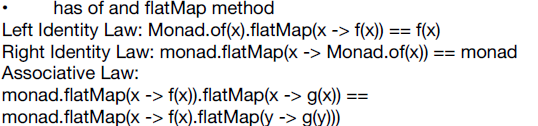
Monads
- of and flatMap methods
Functors
- of and map methods
